Answer: Absolutely none. The authors are no charged any processing or publication fee. The readers can access and use the content of the journal free of charge under a Creative Commons Attribution-NonCommercial-NoDerivatives 4.0 International License (CC BY-NC-ND).
 .
.Answer: The journal does not provide any author services, except for the peer review. Unlike other journals, we do not edit the manuscripts to fit the Author Guidelines. It is the duty of the authors to submit the articles in a "ready for publication" format. We simply assess whether the Author Guidelines are strictly observed, and desk-reject the manuscripts showing any deviation. In addition, our journal does not provide to authors, reviewers, or members of the Editorial Board any certificates. Those who need an official document may receive per request a confirmation e-mail, and, only in very well justified cases, a letter signed by the Chief Editor, with no seals or stamps, available only in electronic format.
Answer: The journal does not have any submission deadline. Articles are received and processed continuously. When six research articles are accepted in their final format, a new issue is produced automatically. The authors can track the process looking under "Accepted papers" (left menu).
Answer: The journal does not publish any articles (except for book reviews and materials under "News and editorials") without peer review. The peer review process is described in the section "Peer review" (left menu). Essentially, the process has two steps. The initial screening is fast, usually 10 days. Most manuscripts are desk-rejected at this stage, usually because the authors do not document their submissions sufficiently, the articles do not make a significant scientific contribution, the English level is not suitable for an international journal, and/or the Author Guidelines are not treated as mandatory rules, but are simply ignored. Only manuscripts that pass this stage are sent to the reviewers. This step can take anywhere between few weeks to several months; articles addressing very specific topics require more time, as it is hard to find qualified reviewers. In general, the peer review process takes longer in civil engineering. In some cases, reviewers ask for specific revisions. In this case, they will review a revised version of the manuscript. The process can take longer if the authors do not properly document the changes made to their manuscripts, do not submit an anonymous letter to the reviewers, or send it in a format specifically prohibited by the Author Guidelines. This second revision can also take several weeks. When the manuscript is accepted, the authors must submit a pledge form; the on-line publication of their manuscript is conditioned by this document. In general, our journal strives for ensuring the best quality of articles at the expense of time. Delays are in most cases due to the authors who do not pay sufficient attention to details such as the Author Guidelines, file format, required documents etc.
Answer: Our journal has a broad scope. Any urban/territorial planning, architecture, or civil engineering contribution fits under its scope. In addition, we can publish contributions from ecology, sociology, economy, history etc. (to name only a few subjects) as long as they address urban/territorial planning, architecture, or civil engineering issues. However, we are a small and independent journal, edited by a research institute. Due to this reason, our primary selection criteria are not so much the fitness of articles with our scope, but there are other two essential conditions. The first is for the articles to comply with our Author Guidelines for formatting their submissions. The second condition is that we explicitly require authors “articles that are well-grounded in the existing literature, showing an up-to-date knowledge of worldwide developments. The reference list must be primarily based on published materials (with ISBN or ISSN) and focused on the mainstream international literature. We recommend authors to limit to a necessary core the list of unpublished materials, especially those not undergoing peer review (Internet websites, unpublished brochures etc.)” Moreover, we do not accept any auto-citation of our journal. For these reasons, we cannot assess the chances of a future article to be published based on a title, abstract, or draft, but only of full submissions, drafted according to the Author Guidelines and fully observing our Editorial Policies.
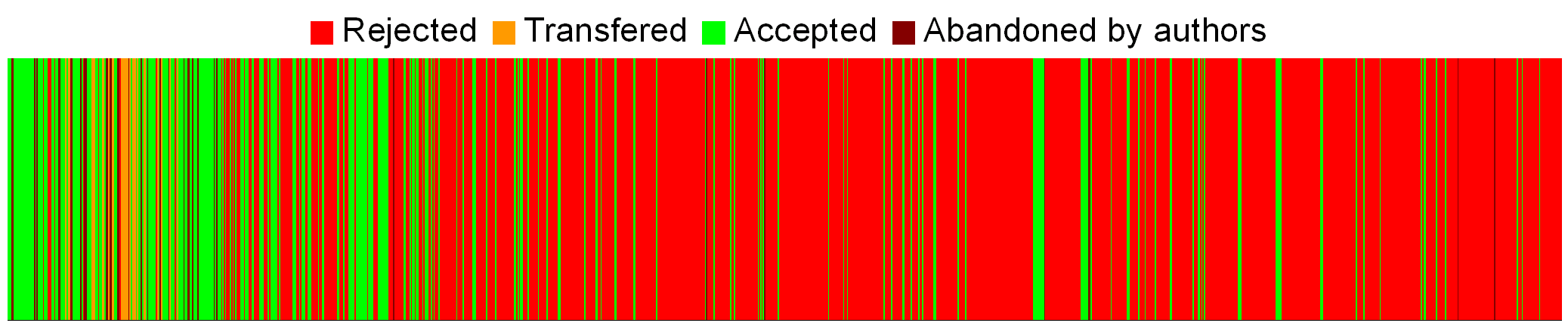
Answer: The rejection rate increased with the prestige of the journal, but also due to the numerous submissions received from countries which, due to cultural reasons, do not treat the Author Guidelines as mandatory rules and ignore them. Currently, the standards of the journal correspond to those of an international journal with respect to contents and format. The two images below display the rejection rate for each year and each article received since 2012.

Answer: The rejections occur at two stages. Most submissions are desk-rejected because (1) the article has little scientific value, makes no significant contributon to the field, and the issue presented in the article is not of broad interest, (2) the submissions are poorly related to the existing literature, (3) the authors fail to comply with the Author Guidelines, (4) the English level is incompatible with an international journal, (5) the submissions do not have sufficient research depth or limit the audience to the city, region, or country where the case study is carried out. Other submissions are rejected during the review process, because (6) the authors fail to indicate how the suggestions of the reviewers were addressed. In each case, the rejection can be avoided as following:
(1) As our Author Guidelines state, we explicitly require authors “articles that are well-grounded in the existing literature, showing an up-to-date knowledge of worldwide developments. The reference list must be primarily based on published materials (with ISBN or ISSN) and focused on the mainstream international literature. We recommend authors to limit to a necessary core the list of unpublished materials, especially of those not undergoing the peer review (Internet websites, unpublished brochures etc.)” In more detail, we are not considering for the review process papers with very few references, papers referring extensively local sources (especially if not published in English) and/or unpublished materials (the list includes, without limiting to: conference presentations, legislation, guides/brochures, unpublished research reports, theses/dissertations, Internet websites etc.) It is highly recommended that the authors look up previous submissions already published, and match the reference lists in terms of size, structure, diversity etc.
(2) Our journal considers the Author Guidelines not simple recommendations, but rules that must be observed strictly, especially in relationship to the references and their citation in the text, including the punctuation (periods, spaces, commas etc.), capitalization, and text formatting; the Author Guidelines provide only the correct form of references for each type (books, articles etc.). If the authors are not familiar with our journal style, they should refer to the additional materials: (A) a guide showing the most common mistakes is available at http://uac.incd.ro/Index/UAC_EN.pdf; please note that the correct form is the one showed in the center, and any deviation (e.g., missing or added elements, including punctuation) leads automatically to the rejection of submissions; (B) a set of detailed guidelines; (C) the journal template for articles, including the detailed Author Guidelines. Also, already published articles can serve as a model whenever the particular formatting of an item is unknown. Finally, it has to be stressed out that our journal uses a unique reference style. We do not encourage the use of programs for reference formatting, because the specific format of our journal is not included, and the use of a different style results into the rejection of submissions. Unlike other journals, we do not offer any services to the authors, including editing manuscripts to fit the Author Guidelines. It is their duty to submit the articles in a “ready for publication” format. We simply assess whether the Author Guidelines are strictly observed, and desk reject the submissions showing any deviation, no matter how insignificant the authors consider it.
(3) Our journal is published in English. Apart for the quality of phrasing and the correct use of the language, we hold the authors responsible for observing the punctuation (periods, spaces, commas etc.) and capitalization rules of the English language. Major and frequent deviations for any of these will result into the rejection of submissions. Authors that are not advanced English speakers should seek for the assistance of a native speaker. It is also highly recommended to proofread the manuscripts before their submission.
(4) The assessment of the research depth is based on how convincing is the introduction in pleading for the need for research based on the shortcomings of the previous studies, the justification of the novelty and originality of research, and a clear discussion of the contribution of the results to the theoretical (conceptual or methodological) advancement of the field. We are also assessing whether the submissions have an international extent. Although the case studies might be local, they need to be compared with similar ones from abroad, and, by showing their scientific message, the article must address an international research audience. The references must also illustrate an international perspective. Also, the maps should show the location of the case study in an international context. Submissions may be rejected if the article is written is such a way that it makes sense only for a local or regional audience, but also if can be understood only by some professionals.
(5) When a submission is accepted for review, the reviewers provide their comments using the journal standard reviewing sheet. However, since the reviewers are mainly responsible for assessing the scientific quality of submissions, the editorial team is also proofreading the submissions. The authors are returned a consolidated review sheet, including comments from the reviewers and the editorial team. The authors are advised, through the document, to (A) make visible the way of addressing the comments (e.g., using “track changes” or highlighting the text using a different font or background color), and (B) write an anonymous letter to each reviewer, explaining the manner of addressing each comment; according to the Author Guidelines, this document must be submitted as a DOC or RTF file. The failure to address the comments in a traceable way or submission of the letters to the reviewers in other formats or revealing the identity of authors can result into the rejection of the revised submission.
Using a boosting language (“your valuable journal”), greetings, or, on the contrary, threats, do not have any influence on the way how submissions are handled. We handle the submissions and not the messages through which they are submitted. The boosting language cannot compensate for any of the shortcomings presented above. Potential authors must understand that our journal is very selective, and only those complying in full with our requirements are further selected. The rejection rate is a clear indication of our selectiveness.
Unlike other journals, we do not offer any services to the authors, including editing manuscripts to fit the Author Guidelines, detailed advise on writing their submission or revising it in case of a desk rejection. We hold the authors responsible for reading carefully each section of our website, as we do not answer any question if its answer can be found on the journal website.
Answer: Our journal has a "zero tolerance" policy for autocitations. We tend to accept no references to articles published in our journal. However, we kindly ask authors interested in citing articles from our journal in other publications to observe the following visual identity guidelines:
Answer: When a submission is rejected, the journal provides a clear explanation for the reasons. Sometimes, when multiple shortcomings are found, the explanation is generic, but contains clear references to the journal website where detailed explanations are available. We hold the authors responsible for reading carefully each section of our website, as we do not answer any question if its answer can be found on the journal website.
The authors should take any reason of rejection seriously, and first of all assess whether they are able to meet the journal standards before resubmitting their article. If they plan to resubmit, then they must address each shortcoming thoroughly (meaning each issue, and all over throughout the manuscript). Our journal has a banning policy against the authors who submit repeatedly the same manuscript, addressing our requests in a careless manner, without paying the greatest attention to the least detail. This means that, if they show no consideration to our journal, we no longer answer their e-mails or consider their submissions. Therefore, the submission of a manuscript is permitted only three times. If shortcomings are still present, the banning policy is instituted.
Using a boosting language (“your valuable journal”), greetings, or, on the contrary, threats, do not have any influence on the way how submissions are handled. For the latter, authors should be aware of the fact that our journal has a banning policy against authors who sent offensive e-mails, meaning that we no longer answer their e-mails or consider their submissions.
As a general rule, the authors must understand that our journal is very selective, and we do not aim to publish every submission received. On the contrary, we are committed to publishing only the best ones; any negotiations aimed at lowering our journal standards have a dead end. If the authors cannot meet our standards, they are most welcome to submit their contribution to another journal, but, if they plan to publish with us, our rejection rate is a clear indication of the fact that we have numerous submissions, so we are selecting only those meeting our standards.
Answer: Please refer to the "Author Guidelines" (left menu). The reason for pointing out to the Author Guidelines is that we hold the authors responsible for submitting the articles in a "ready for publication" format. We simply assess whether the Author Guidelines are strictly observed, and desk-reject the manuscripts showing any deviation. Authors who ask this question show that they did not read the Author Guidelines, which is likely to result into a desk rejection of their manuscript. The Author Guidelines specifically indicate that submissions are made by e-mail, attaching the article; if the files are too large, the authors should use a file transfer services, indicating their own address, and write a separate e-mail providing the article link instead of indicating the journal address in the file transfer application or forwarding the message received from it.
Answer: If authors use their institutional address or a GMail address for contacting the journal, chances are for the answer to be automatically labeled as "Spam" by their institutional mail / GMail server. The authors should first of all make sure that the journal address is added to the "safe" list, check also their "spam" (or equivalent) folder, and use their private address, but not GMail, as much as possible in the correspondence with the journal.
Answer: The answer is NO. Our journal belongs to the scientific realm, is offered free of charge to the academic community (authors and readers), and we consider any commercial proposal to be offensive by nature. We are not interested in proposals favoring specific groups, and are aiming to ensure the diversity of articles, including through an even geographical distribution of authors.