materiale de prezentare a unor conferinţe din domeniu sau alte evenimente de interes ştiinţific, evocări sau prezentări ale unor personalităţi din domeniu, informări din partea redacţiei revistei, recenzii de carte The peer review process, defined as “obtaining advice on individual manuscripts from reviewers expert in the field of publication”, is double blind until the publication of papers. More exactly, the identity of those evaluated and evaluating is not disclosed to each other during the peer review process. Reviewers who acted during the publication of two consequent issues are acknowledged collectively in the latest issue, without indicating what articles each of them evaluated, using their first initials and last names, except for those specifically stating that their names should not be disclosed, and included in the Reviewer Board, unless they request otherwise. Peer review consists, for “Urbanism Architecture Constructions”, of three stages, presented in the image below, namely: initial assessment, evaluation by peer reviewers, and copy-editing.
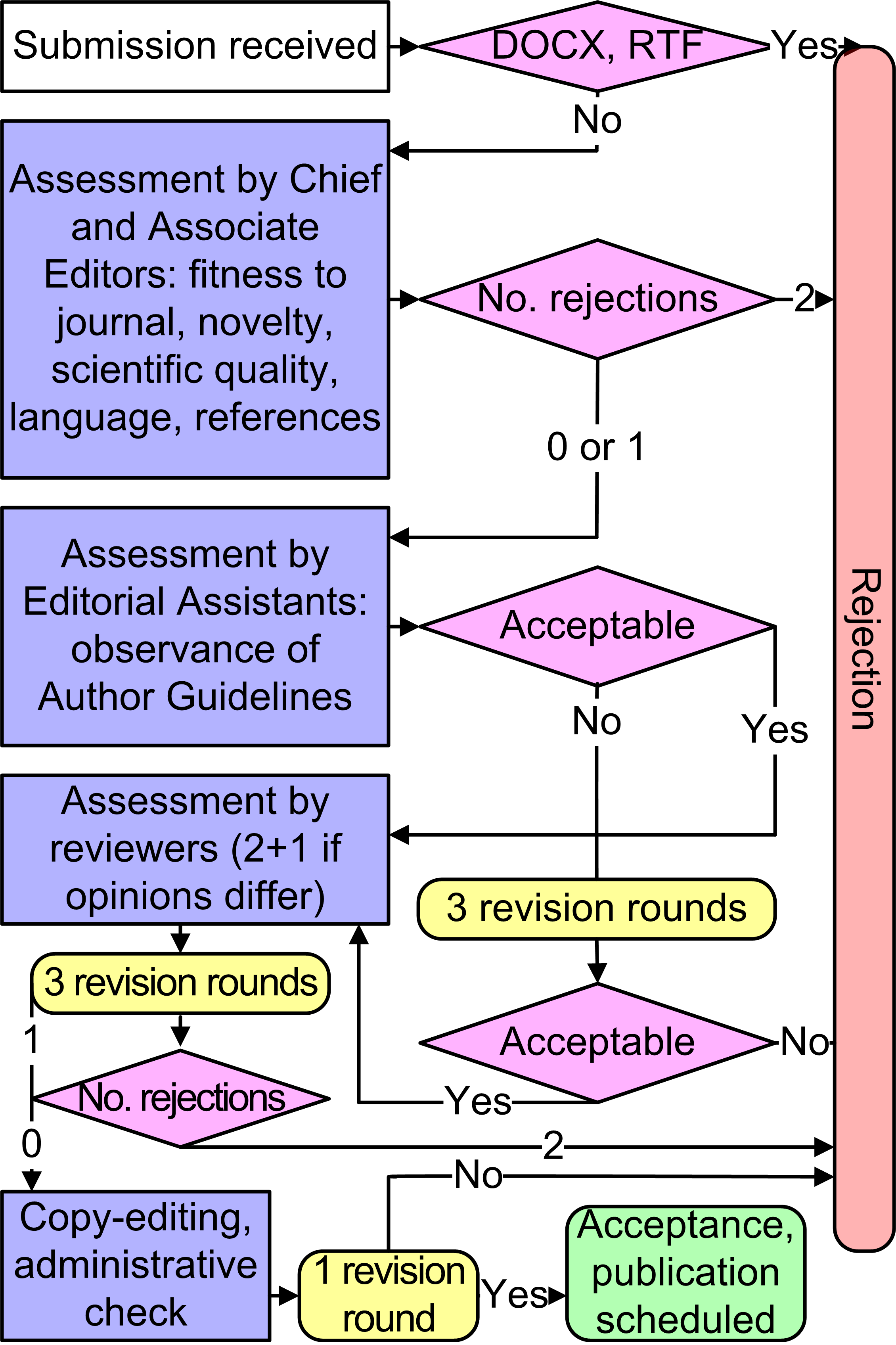
(1) In the first stage, submissions will be checked by the Chief and Associate Editors. If the article is of potential interest to the readers, makes a significant contribution to the field, is scientifically valuable, and the issues noticed before can be corrected, the article is further sent to the Editorial Assistants, who check in detail the observance of Author Guidelines and correctness of languageș if they find out that the Author Guidelines are not observed or notice major problems, they may reject the articles or point out the errors to authors. Authors have three revision rounds, including the initial submission (that is: initial submission and two revisions) to solve the problems; if errors are still present in the end, the article is rejected, and authors informed on the decision. Authors who refuse to comply with the Author Guidelines and Editorial Policies are banned (meaning that subsequent e-mails from the banned authors will receive no answer) if they submit repeatedly a rejected manuscript without addressing the issues determining the rejection, and in response to different forms of academic misconduct, such as sending their submissions to the private addresses of editorial team or other addresses than the one indicated on the contact page. Banning applies to both authors and submissions.
(2) Articles that pass successfully the first stage are reviewed by two external reviewers from a different institution and, if possible, country than the author, receiving a copy that does not contain the name and affiliation of authors or other identifying information (e.g., name of the funding grant). If reviewers find or suspect the identity of authors, they must act regardless of the ethnicity, gender, sexual orientation, citizenship, religious beliefs or political orientation of the authors, or report to the Editor any potential conflict. If there are minor differences (i.e., both reviewers recommend the acceptance or rejection), the decision is taken by the Chief Editor and is based on the recommendations of reviewers correlated with the importance of the submission, assessed in accordance with the Editorial Policy. If their opinions differ substantially (i.e., one reviewer recommends the rejection and the other the acceptance), a third reviewer will be contacted. If the reviewers require revisions, authors must submit, in addition to the revised manuscript, an anonymous letter stating the changes performed or motivating the refusal to address them. In the next round, reviewers will be asked to assess whether their suggestions were properly addressed. No more that three revision rounds are allowed, including the initial submission (that is: initial submission and two revisions). If, after the three rounds, reviewers consider that some comments were not addressed, the article is automatically rejected. The authors will be informed on the editorial decision. Authors who refuse to revise their article or convince the reviewers by providing solid and comprehensive arguments for their refuse are banned (meaning that subsequent e-mails from the banned authors will receive no answer). Banning applies to both authors and submissions.
(3) Once the authors are informed of the editorial decision immediately after the reviewers have evaluated the article, the journal will request them to submit a pledge form through which they assume the responsibility for the originality of the article and other ethical issues. The failure to submit the pledge form or its submission in a format different from the one enforced by the journal results into the rejection of submission. The submission is also rejected if the authors do not mark the changes made based on the comments of reviewers, do not submit a letter showing how they addressed these comments, or the documents are submitted in a format different from the one enforced by the journal. After accepting the article, the journal will prepare the article for publication. In a first stage, the article is displayed on the journal website, under the “Accepted Papers” section, in a format differing from the final one only by page numbering, which in this case starts from 1, with an indication of the volume and issue featuring it. In order to prepare the article, the journal may correct spelling and punctuation, and ensure compliance with the Author Guidelines. If major deviations are noticed, the manuscript will be returned to authors for revisions. If the authors fail to make the requested changes, having only one round available, the article is rejected. Articles rejected at this stage can be resubmitted, provided that the issues that led to their rejection are resolved, without being re-evaluated by the reviewers (the initial evaluations are used). Authors who refuse to correct the articles are penalized by banning them and their submissions (their messages will no longer be answered).
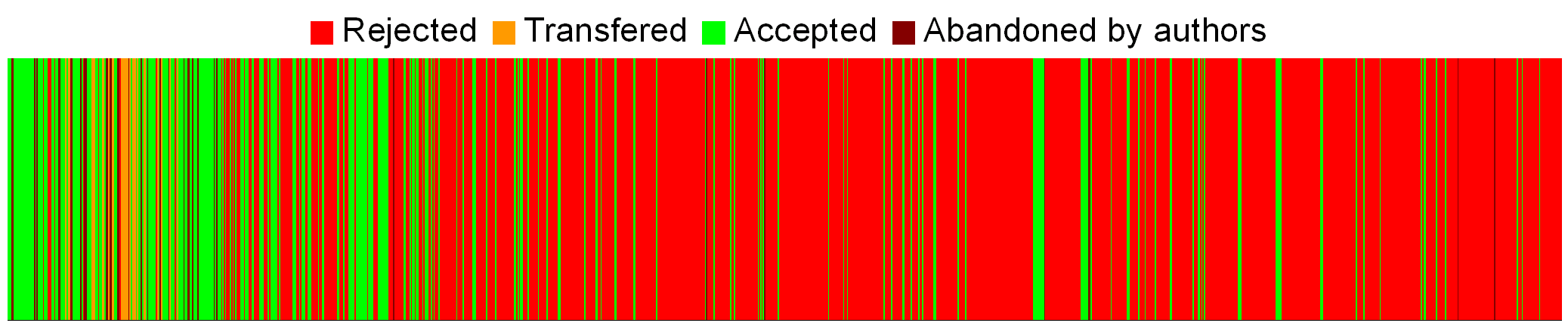
The rejection rate increased with the prestige of the journal. Currently, the standards of the journal correspond to those of an international journal with respect to contents and format. The two images below display the rejection rate for each year and each article received since 2012.

As it can be seen, the journal has three levels of decision. The lowest one is represented by the board of external Reviewers, who assess the articles with respect to their scientific soundness and recommend their acceptance or rejection. The intermediate one belongs to the Editorial Board, which can recommend a decision if two reviewers have different opinions in relationship with the same article. In addition, they can recommend editorial policies, and are responsible for promoting the journal in the academic and research environment; in this regard, they can recommend the association of the journal with different conferences or other scientific events. The highest decisional level is represented by the Chief Editor and Editors. Their responsibility ranges, in this order, from decision making to its implementation, in relationship to the editorial policies and content of the journal. They are directly responsible, in the opposite order, for overruling the decisions of the reviewers, if the article is not suitable for the journal, and for mediating potential conflicts between authors and reviewers. The decision of rejecting articles that are not suitable for the journal is taken prior to sending it to the reviewers, but can also be taken after the review in case of major incompliance with the editorial policies and guidelines. All the people from the higher level can perform reviews if there are no external reviewers covering the specific area tackled by the article.